Spider rigging has long been a productive crappie technique, especially across Southern waters where slow trolling with multiple rods is a familiar sight. While modern electronics have enhanced the approach, the fundamentals remain unchanged: spread baits wide, control speed, and stay in the strike zone. When done correctly, spider rigging allows anglers to efficiently locate and catch crappie across large sections of open water.
What Is Spider Rigging?
Spider rigging is essentially controlled trolling with several long rods extending from the bow of the boat. The rods are fanned outward, resembling spider legs, allowing anglers to fish multiple depths and cover a wide swath of water at very slow speeds. This technique is especially effective when crappie are scattered or holding near structure in open basins.
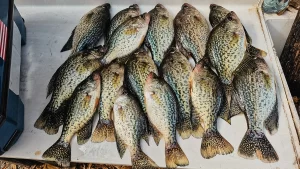
Setting Up a Spider Rig
A proper spider rig begins at the bow. Most setups use rod holders arranged evenly across the front deck, with the number of rods determined by crew size and comfort level. Six to eight rods is a common and manageable spread for many anglers, offering excellent coverage without becoming overwhelming.
Rod length plays a major role in success. Longer rods, typically between 14 and 16 feet, help keep lines separated and push baits away from the boat. Sensitivity is critical, as spider rigging bites are often subtle. Rods designed specifically for the technique are preferred for their balance and ability to telegraph light pressure bites.
Spacing rods evenly is essential. Proper spacing reduces line crossover when adjusting speed or direction and makes handling multiple hookups far more manageable. A clean spread also improves bite detection, allowing anglers to react quickly when a rod loads up.
Choosing the Right Rod Holders
Running multiple rods off the bow requires a dependable rod holder system. Adjustable holders allow anglers to fine-tune rod angles and spacing, which is especially important when fishing slowly with long rods.
Popular spider rigging rod holder systems include:
-
Tite-Lok, known for easy adjustability and reliable performance
-
HiTek Stuff, widely used in tournament circles for its modular design
-
R100 Spyderlok Gen 2, a compact system ideal for tight bow layouts
-
Extreme Fishing Concepts (EFC), favored for heavy-duty stability when running long rods
The right rod holders improve control, reduce tangles, and keep the entire spread fishing efficiently.
Speed Control Is Critical
Speed is one of the most important variables in spider rigging. Even the best setup will struggle if baits move too fast or drift out of the strike zone. Most anglers maintain speeds between 0.3 and 0.5 miles per hour, particularly in colder water around 50 degrees or less.
Small speed adjustments can trigger bites, especially when crappie follow baits without committing. Wind, current, and depth all affect speed, making constant monitoring essential. Too much speed causes baits to rise and rods to angle back, often resulting in fewer bites.
Best Lures for Spider Rigging
Spider rigging works with a wide range of baits, but simplicity and depth control matter most. Jigs remain a staple, with shad-style plastics and tube jigs being especially popular. These baits allow precise depth control and consistent presentation.
Spinner jigs are often added to the spread when extra flash is needed, particularly in stained water. Underspin styles perform well at slow speeds and help crappie locate baits. In tougher conditions, many anglers add live minnows or run jig-and-minnow combinations to entice reluctant fish. Regardless of bait choice, maintaining the correct depth is far more important than lure style.
Hooking and Landing Fish
When a rod loads up, smooth and controlled action is key. The fish is typically already hooked, so lifting the rod steadily and reeling immediately is more effective than an aggressive hookset. Keeping the rod extended helps prevent tangles with neighboring lines.
If lines do cross, continuing to reel often results in landing the fish. Attempting to untangle lines while the fish is still in the water frequently leads to lost fish. Once the fish is landed, lines can be reset and adjusted.
Spider rigging may look complex at first, but proper rod spacing, precise speed control, and consistent depth management quickly simplify the technique. Once dialed in, it becomes one of the most reliable methods for locating crappie and staying on fish throughout the day.
Image/Source: Wired2Fish