Scientists have long studied how people make decisions when searching for food, but a recent study used an unusual setting to gather real-world data: ice fishing competitions. Researchers from an international team analyzed how anglers balance personal experience with information gathered by watching others. The findings, published in Science, offer insight into how humans make decisions in complex and social environments.
During the study, 74 experienced ice fishers participated in competitions across eastern Finland. Participants were equipped with GPS watches and wearable cameras that tracked their movements, fishing attempts, catches, and travel routes. Over the course of 477 fishing outings on 10 lakes, researchers recorded more than 16,000 individual decisions related to where anglers chose to fish and when they decided to move to a new location.
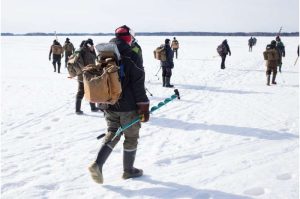
Using this detailed dataset, scientists created computational models designed to explain how anglers made decisions while competing. The results showed that participants relied on three main sources of information: their own fishing success, the behavior and locations of nearby competitors, and environmental factors such as lakebed structure and fish distribution.
The study revealed that success plays a major role in decision confidence. Anglers who were catching fish consistently tended to rely more on their own knowledge and past experience. Those who struggled to catch fish were more likely to observe and follow the actions of others nearby.
Researchers also observed a behavior known as area-restricted search. After catching a fish, anglers often increased their fishing effort in the immediate area, assuming more fish might be nearby. This behavior became even stronger when many competitors were clustered together in the same zone. Meanwhile, anglers who went long periods without a catch were more likely to relocate to new fishing spots.
Demographic differences also appeared in the results. Women in the study generally relied more on social information compared to men. Older participants tended to stay longer in one location and were less likely to abandon areas that were not producing fish. The study also found that when fish populations were high, anglers tended to move more frequently between spots.
Beyond fishing, the study highlights how combining field data with advanced modeling can help scientists better understand decision-making in real-world situations. Researchers believe this method could be useful for studying human behavior in fields such as conservation, resource management, and crowd dynamics.
Ultimately, the research shows that even in a frozen lake competition, human behavior follows patterns that can be measured, modeled, and predicted. As technology continues to improve, similar tracking methods could help scientists better understand how people respond to competition, scarcity, and social pressure in everyday life. Future research may expand into other outdoor activities, helping build smarter strategies for managing shared resources while still allowing individuals to compete and succeed.
Image/Source: phys